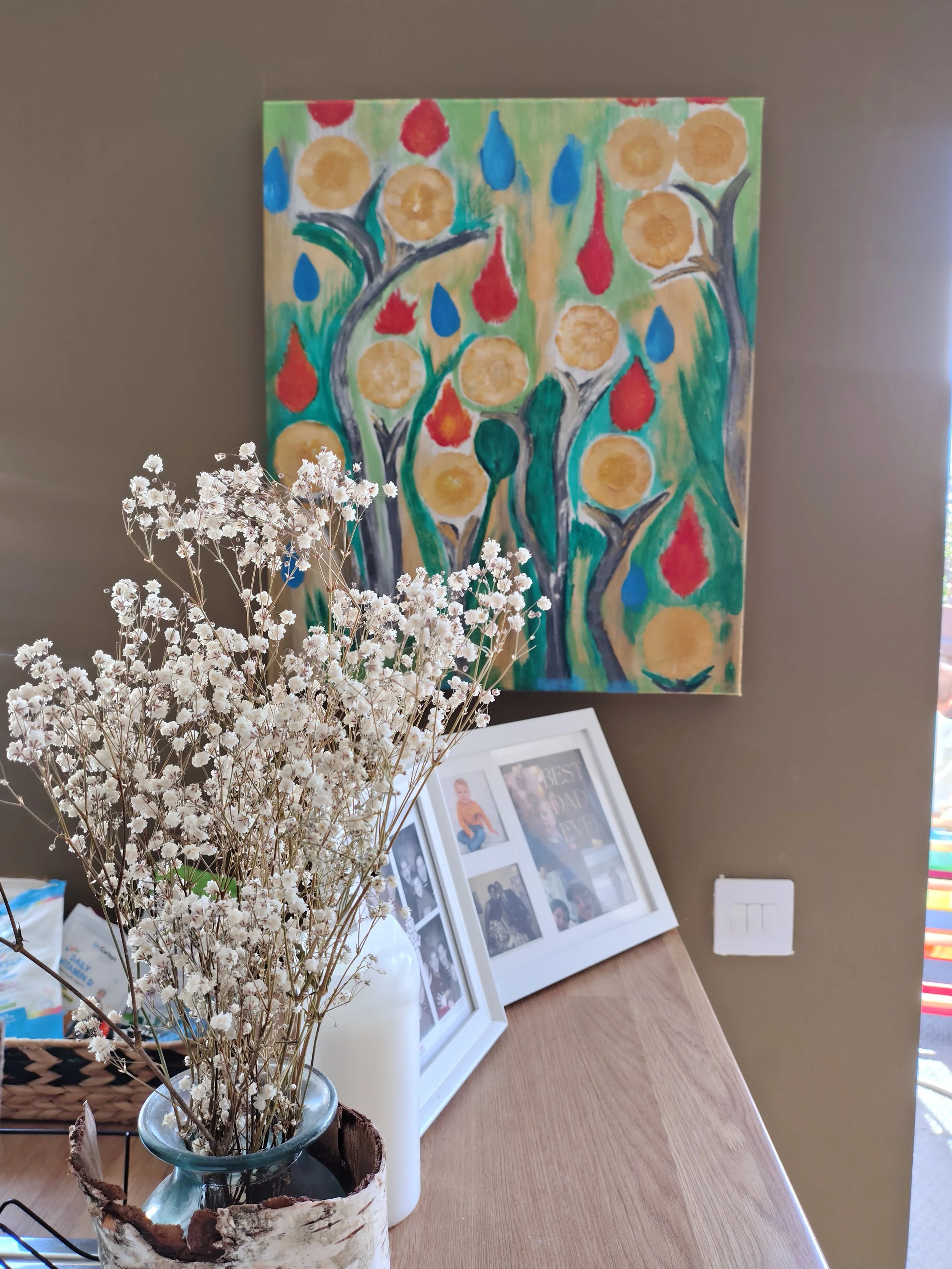


This painting was born in a moment when I was trying to remain in solitude and silence, one early morning. I remember it being a sunny day, although the quietness of that moment felt far removed from the brightness outside.
I began with an intention to experiment. I had some white quartz crystals and wanted to explore texture, light and the possibility of bringing natural elements into the surface of the canvas. But as soon as I primed the canvas, something unexpected began to emerge.
The black and white spoke to me first.
It reminded me of a birch tree — something deeply familiar from Lithuania, where birch trees are part of the landscape and, perhaps without me realising it, part of my own visual memory. I left that impression pale within the painting and began to work around it, introducing flowers and allowing the image to develop through instinct rather than a fixed plan.
Some of the decisions I made along the way were questionable. Others simply felt right in the moment. Eventually, red entered the canvas.
The flowers began to resemble fire.
And somewhere within that transformation, the name Fire Flower found its place.
But the painting was not finished.
Some time later, when a new set of paints arrived, I found myself looking at the canvas differently. I decided to return to it — not with regret for what had been painted before, but with the feeling that something was still waiting to emerge.
I painted over parts of its previous life, while deliberately leaving traces of what had been there before.
The canvas therefore exists as more than one moment.
There is the quieter, more restrained version — the first expression, shaped by solitude, memory and uncertainty.
And there is the painting as it exists today — more vibrant, more alive, but still carrying fragments of its earlier self beneath the surface.
Fire Flower is a journey between the two.
A painting changed by time, by new colour, and by the decision to continue rather than start again.